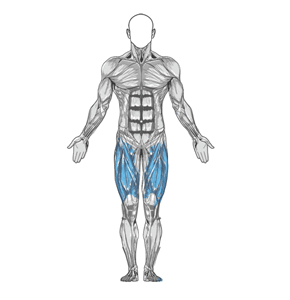
| Main Muscle Targeted | Quadriceps |
| Exercise Type | Strength |
| Auxiliary Muscles Worked | Calves, Gluteus Maximus, Hamstrings, Lower Back |
| Equipment | Barbell |
| Mechanics Type | Compound |
| Exercise Level | Intermediate |
| Applied Force | Push |
| Sport |
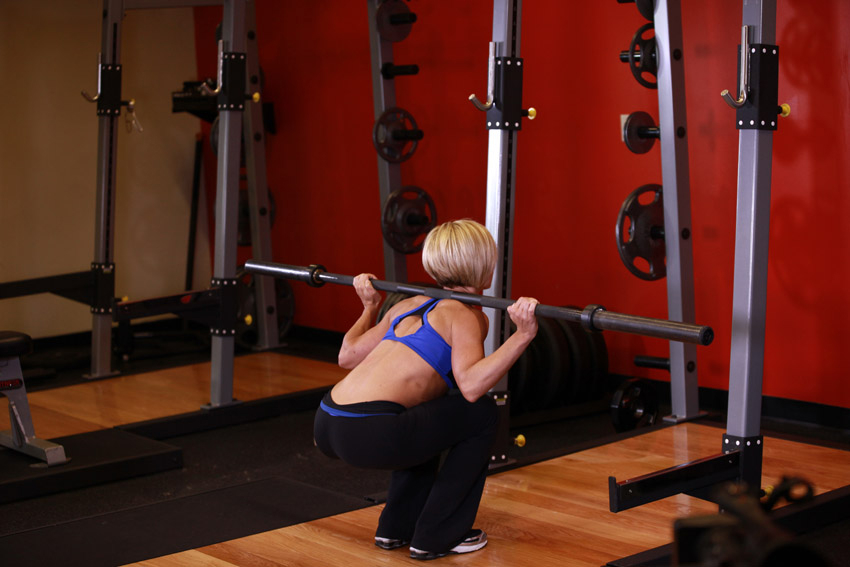
Instructions
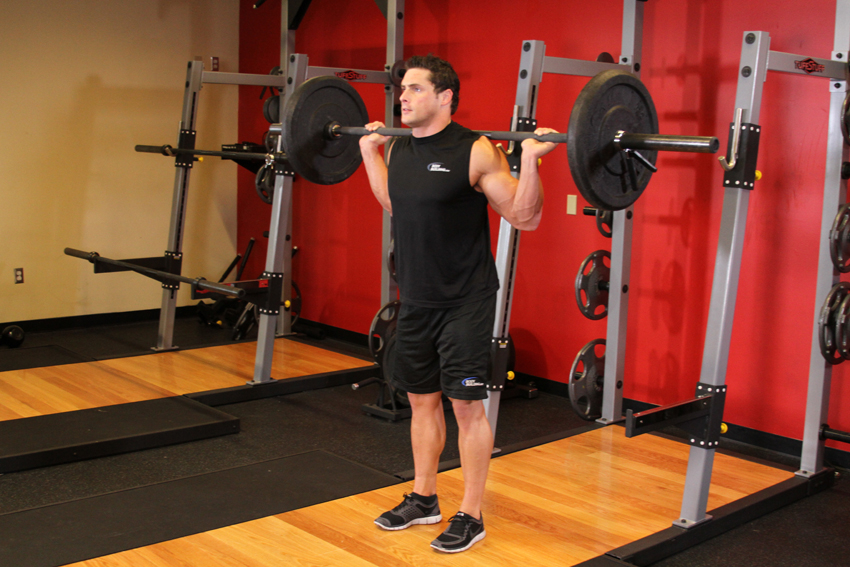
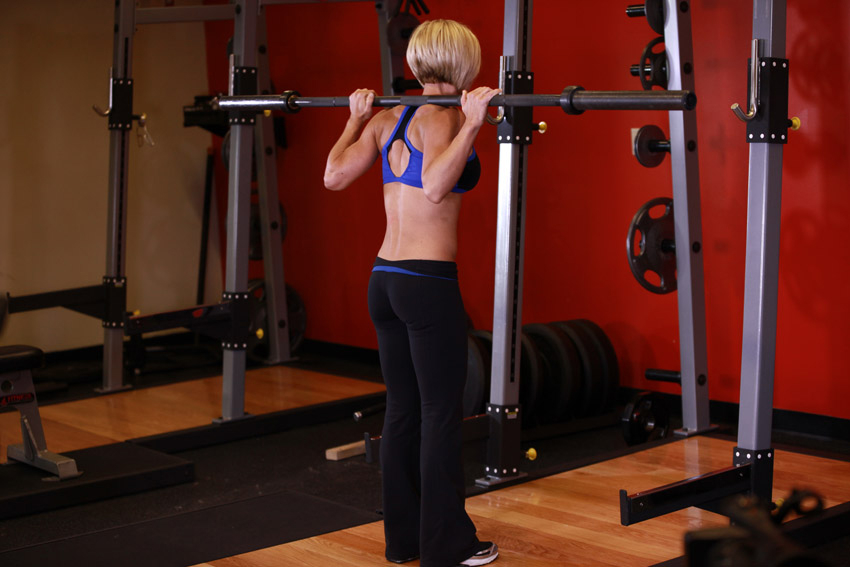
1) This exercise is best performed inside a squat rack for safety purposes. To begin, first set the bar on a rack that best matches your height. Once the correct height is chosen and the bar is loaded, step under the bar and place the back of your shoulders (slightly below the neck) across it.2) Hold on to the bar using both arms at each side and lift it off the rack by first pushing with your legs and at the same time straightening your torso.
3) Step away from the rack and position your legs using a less-than-shoulder-width narrow stance with the toes slightly pointed out. Feet should be around 3-6 inches apart. Keep your head up at all times (looking down will get you off balance) and maintain a straight back. This will be your starting position. (
Note:
For the purposes of this discussion we will use the medium stance described above which targets overall development; however you can choose any of the three stances discussed in the foot stances section).
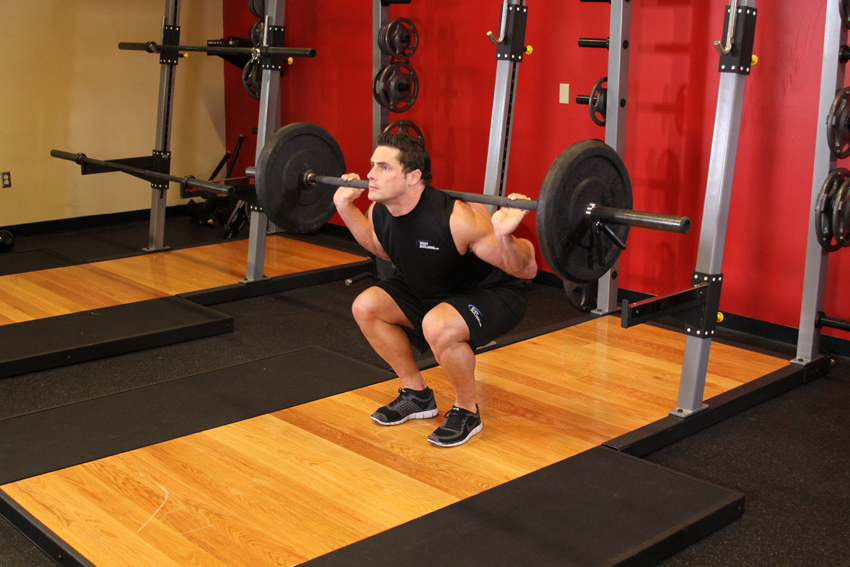
4) Begin to slowly lower the bar by bending the knees as you maintain a straight posture with the head up. Continue down until the angle between the upper leg and the calves becomes slightly less than 90-degrees (which is the point in which the upper legs are below parallel to the floor). Inhale as you perform this portion of the movement.
Tip:
If you performed the exercise correctly, the front of the knees should make an imaginary straight line with the toes that is perpendicular to the front. If your knees are past that imaginary line (if they are past your toes) then you are placing undue stress on the knee and the exercise has been performed incorrectly.
5) Begin to raise the bar as you exhale by pushing the floor with the heel of your foot mainly as you straighten the legs again and go back to the starting position.
6) Repeat for the recommended amount of repetitions.
Caution:
This is not an exercise to be taken lightly. If you have back issues, substitute it with the dumbbell squat variation or a leg press instead. If you have a healthy back, ensure perfect form and never slouch the back forward as this can cause back injury. Be cautious as well with the weight used; in case of doubt, use less weight rather than more. The squat is a very safe exercise but only if performed properly.
Variations:
Variations:
As previously mentioned, there are various stances that can be used depending on what you want to emphasize.
You can also place a small block under the heels to improve balance.
Dumbbells can be used as well for resistance by holding them to your sides. The use of wrist wraps is a necessity due to the amount of weights used. I find this an excellent variation when my lower back begins to act up after many weeks of regular barbell squats. (
Note:
For wide-stance dumbbell squats you will have to hold the dumbbells in between your legs as opposed to both sides in order to be able to distance your legs sufficiently).
Another way to perform these is by using a weight belt and attaching weights to it in between the legs. This variation is referred to as weight-belt squats which need to be performed with the legs placed on two well secured, raised, but separated platforms, that allow the weights to go up and down in the middle. This exercise is an excellent choice for people with lower back problems. The issue however is finding the platforms that meet the criteria. The only way I have been able to perform this is when I have two benches placed opposite to each other with spotting platforms that are facing each other. If you move the benches close enough then you get can execute the weight-belt squats by using the spotting platform.
Finally, you can also perform squats in a Smith Machine though I do not recommend this. The reason for not performing regular squats on the Smith Machine is that since the machine allows you to execute the exercise while leaning versus the bar, hip flexor involvement is minimized taking the hamstring out of the exercise. While this does take pressure off the lower back, hamstring involvement is a requirement to stabilize the knee-cap. So, as a result, what is created is a situation where destructive forces place a huge stress on the ACL (anterior cruciate ligament; a primary ligament in the knee capsule whose job is to provide knee stability) by pushing the knee-cap forward. For this reason, I highly recommend against Smith Machine use for squats. If you still insist on doing so, make sure it is a sporadic use rather than frequent, and also be sure to control the amount of weight used.